The Partnership Viability Matrix: A Framework to Save Time
Your time and focus are your company's most precious resources. You need to vet which partners have access to them; stop giving them away to unqualified partners.
Kipyegon Bett
11/5/20254 min read


You take a sip of your coffee as you conclude the meeting. That interaction felt good to you. The other founder was energetic, their vision was exciting, and you talked about all the ways you could synergize. As you shake hands and walk away, you vaguely promise to follow up. Fast forward to a week later and after a few emails, the energy has fizzled. It dawns on you that you've wasted your most valuable assets, your time and focus, on a partnership that was never going to happen.
This is a scenario that has happened and keeps happening to many leaders as they seek partnerships to take their companies to greater heights. I firmly believe that building an ecosystem is a sure way of ensuring business success and that partnerships are key to achieving that.
The reality is that most partnership strategies are based on gut feeling and reactive conversations. It stops being a strategy and becomes a recipe for burnout and failure. We can save more time if we integrate a simple but rigorous system for qualifying partners before we invest our energy.
The Partnership Viability Matrix is a simple 2x2 framework I use to diagnose any potential partnership. It replaces gut feeling with strategic clarity to simply filter out what doesn’t match your goals and needs.
The Framework
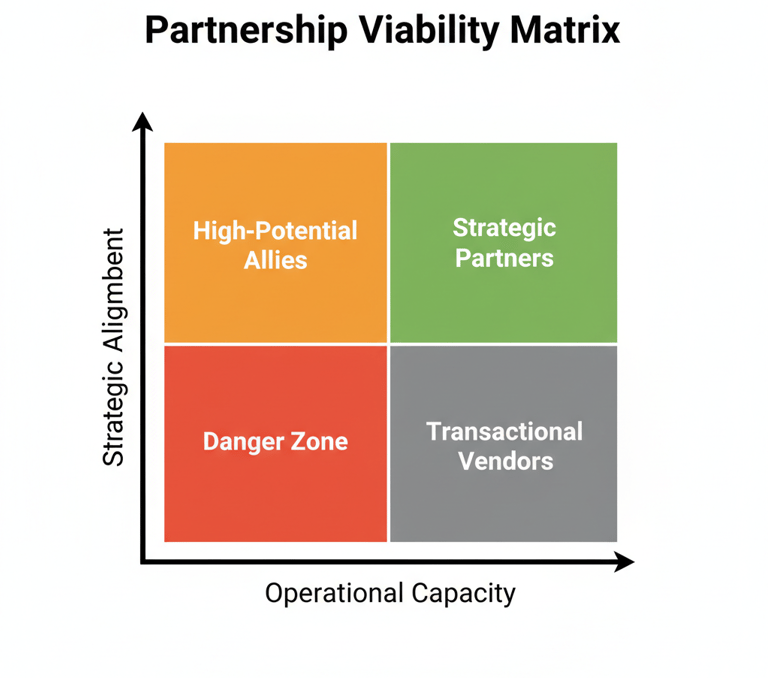
The matrix evaluates potential partners on two non-negotiable axes:
1. The Y-Axis: This axis is everything to do with Strategic Alignment: the Why. It is built around answers to questions such as: How perfectly do their long-term goals, their values, and their desired outcomes align with mine? Is there a win-win result if we work together? Putting it simply: High alignment means you are in the same boat, rowing in the same direction; low alignment means you are on different boats and they are not rowing.
2. The X-Axis: This axis seeks to understand the Operational Capacity of the potential partner: the How. The answers to this question will make it clear: Do they have the actual resources, team, processes, and expertise to deliver on what they promise? To put it bluntly: Can they execute?
The Four Quadrants
Quadrant 1: High Alignment / High Capacity - The Strategic Partners
These are tier 1 partners and they are rare; fewer than 5% of your partners will be in this box. They share your vision and have the power to execute.
When you find one, it’s all systems go; you invest your time, leadership, and resources in this partnership. Where possible, you should integrate your teams and processes because their success is more or less your own.
Quadrant 2: High Alignment / Low Capacity - The High-Potential Allies
You have mutually shared values and goals with these partners but they lack the resources or experience to see things through. They are your future strategic partners for sure but they need time to grow; they are still in incubation.
You will be tempted to, but do not treat them like a Strategic Partner; it will lead to frustration. If you can, the strategic play is to help them level up. You can offer guidance, mentorship and importantly, connect them with resources. Something I have done before is to co-develop a grant proposal where part of the funding is dedicated to building their capacity. The caveat here is that your engagement should be limited and conditional on their growth.
Quadrant 3: Low Alignment / High Capacity - The Transactional Vendors
To meet your professional obligations, you need these partners even though you have no shared value and goals. Established and capable organizations that provide a specific service you need to execute, fit this box. It could be a logistics company, a software provider, or any of the varied service or product suppliers you interact with.
The relationship here is important but you require crystal-clear boundaries. With these partners, you need to prepare a detailed Scope of Work with clearly defined deliverables. The two of you have a transactional relationship governed by a contract and managed through professional communication.
Quadrant 4: Low Alignment / Low Capacity - The Danger Zone
This last quadrant describes people or organizations that are well-intentioned but lack focus. They usually require endless meetings around vague ideas. Additionally, they will often lack a clear plan and the resources to execute it.
The most important skill as a leader is the ability to say NO quickly and professionally. In no other quadrant is this skill more applicable. Your response must be a firm but polite disengagement that protects your time.
The Mandatory Prerequisite: The Mirror Test
Before you can effectively use this matrix on others, you must first apply it to yourself. It is meaningless if you don’t have absolute clarity on your own position either as a leader or an organization.
Carve out quality time to find out the answers to these questions: What are your strategic goals? What unique value do you offer and critically, what are your operational gaps? Without this self-awareness, you risk being the High-Potential Ally or, worse, the Danger Zone in someone else's matrix. True partnership strategy begins with your own rigorous self-assessment.
Your time and focus are your company's most precious resources. You need to vet which partners have access to them; stop giving them away to unqualified partners. This matrix is a great strategy that doesn’t only tell you what to do; it also helps you choose what not to do.